Online Roundtable Forum: Opportunities and Challenges in the Middle East Following the U.S.-Iran Ceasefire
I. Forum Core Information
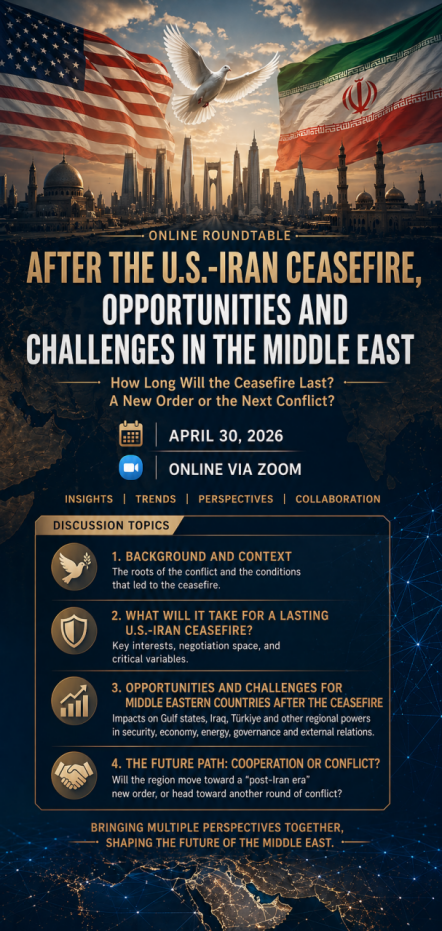
Theme:Opportunities and Challenges in the Middle East Following the U.S.-Iran Ceasefire
Date: April 30, 2026
Format: Online Zoom Meeting
II. Forum Background
The current geopolitical landscape of the Middle East is undergoing a period of profound adjustment, wherein regional security, the energy order, and great-power competition are evolving in a deeply intertwined manner. The conflict involving Iran—which spanned from February 28 to early April 2026—has seen a phased de-escalation. Mediated by Pakistan, the United States and Iran reached a provisional ceasefire agreement on April 7–8; the duration of this ceasefire has since been extended until the conclusion of ongoing negotiations.
This conflict has profoundly impacted the regional landscape: the Iranian regime and its defense infrastructure have suffered severe blows; infrastructure in Gulf states—such as the UAE—has sustained damage; the regional security architecture has shifted further in favor of the U.S. and Israel; and Iraq’s strategy of balancing between great powers now faces intensified pressure. To clarify the prospects for the ceasefire and assess the trajectory of the regional order, this forum focuses on key issues to conduct in-depth discussions, offering expert analysis and pragmatic insights for understanding the shifting dynamics of the Middle East.
Participants: The forum brings together senior scholars, policy researchers, and regional affairs experts from various nations—including the UAE, Iraq, Iran, and Turkey. Drawing upon their respective fields of research, these distinguished guests will employ diverse perspectives to collectively explore the trajectory of the Middle East situation and contribute their professional insights.
III. Core Discussion Topics
This online roundtable forum systematically reviews the origins and context of the recent U.S.-Iran conflict, as well as the factors leading to the ceasefire. It offers an in-depth analysis of the core interests, scope for maneuver, and critical variables influencing the potential for the U.S. and Iran to achieve a lasting ceasefire. Furthermore, by focusing on key regional actors—such as the Gulf states, Iraq, and Turkey—the forum provides a multi-dimensional assessment of the dual opportunities and tangible challenges that the ceasefire situation presents to various Middle Eastern nations across the domains of security architecture, economic and energy affairs, internal governance, and foreign relations. Finally, taking a holistic and forward-looking perspective, the forum evaluates the evolving trends of the Middle East’s geopolitical landscape, exploring whether the region is poised to enter a new “post-Iran era” order, or if it is destined to once again descend into a future defined by conflict and strategic rivalry.
IV. Forum Value and Vision
Grounded in a global perspective and geostrategic analysis, this roundtable forum leverages specialized research and international dialogue to deliver cutting-edge insights, thereby assisting all stakeholders in clearly assessing complex global challenges.
By bringing together the perspectives of experts from various nations, the forum fosters pragmatic exchanges and rational dialogue. It is dedicated to enhancing mutual understanding and forging consensus, offering intellectual support for regional stability and cooperation through strategic foresight and rigorous analysis, and promoting the construction of a more resilient landscape of security and governance.