The “Shield of the Americas” Summit and the “Anti-Cartel Alliance of the Americas”: Implications for and Responses by Foreign Enterprises Operating in Latin America
Lucas chow – Senior Researcher
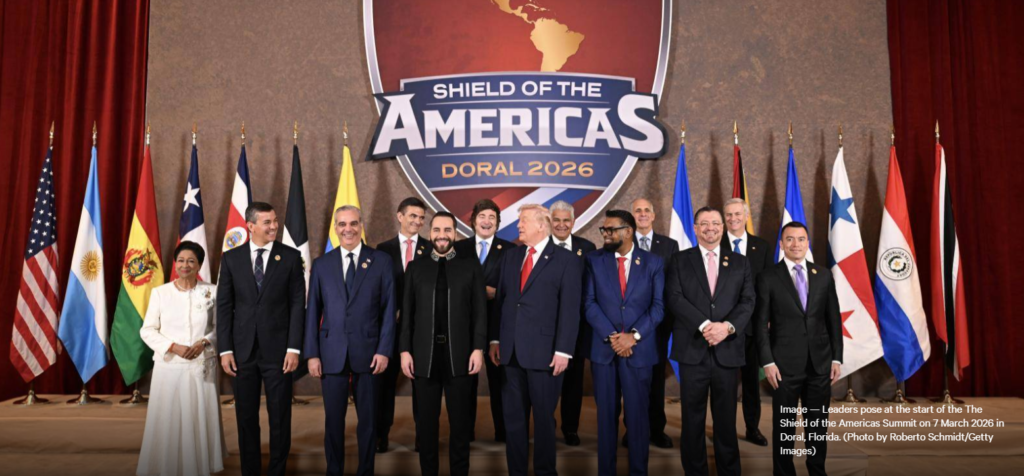
Against the backdrop of the United States waging a high-intensity localized conflict against Iran, Washington has refocused its strategic gaze back toward the Western Hemisphere in an effort to consolidate its strategic rear. On March 7, the Trump administration hosted the inaugural “Shield of the Americas” Summit in Florida, signing agreements with 17 right-wing and center-right Latin American and Caribbean nations to formally establish the “Anti-Cartel Alliance of the Americas.” While the summit ostensibly focused on combating transnational drug trafficking and illegal migration, its true objective was for the U.S.—leveraging a “Trump-era Monroe Doctrine”—to militarize regional security and consolidate its hegemony within the Western Hemisphere. This move fundamentally reshapes the security landscape of Latin America, posing profound challenges to the operational strategies, compliance management, and risk mitigation efforts of multinational corporations operating in the region—particularly those of non-U.S. origin.
I. Summit Details
The summit was held on March 7 at the Trump National Doral Golf Club in Miami. The U.S. delegation featured a core cabinet lineup, including the President and the Secretary of State; former Secretary of Homeland Security Kirstjen Nielsen was appointed as the Special Envoy for the “Shield of the Americas,” tasked with coordinating the alliance’s daily operations and military activities. This organizational structure establishes a mechanism for normalized U.S. intervention in Latin America, thereby directly impacting the security environment in which foreign enterprises operate.
The nations invited to the summit consisted exclusively of pro-U.S., right-wing, and center-right regimes. Heads of state from countries such as Argentina and El Salvador were in attendance, and Chile’s President-elect even broke with diplomatic tradition to participate; notably, however, the three major Latin American powers currently governed by left-wing parties—Brazil, Mexico, and Colombia—were not invited. This factionalized arrangement has exacerbated geopolitical divisions within Latin America, widened the disparities in operating environments across different countries in the region, and increased the complexity of formulating regional business strategies for foreign enterprises.
In his opening address, President Trump advocated for the use of missile strikes to resolve security issues in Latin America, pledging that—upon the request of partner nations—the U.S. would be prepared to deploy high-precision missiles to target the ringleaders of drug cartels. He also singled out Mexico for stern criticism, declaring that he would not rule out the possibility of unilateral cross-border strikes. This hardline stance heightens the risk of geopolitical conflict in certain parts of Latin America, posing a direct threat to the safety of foreign corporate personnel and assets. During the summit, Trump prominently highlighted the joint U.S.-Ecuadorian military operations against illegal armed groups in Colombia, using this as leverage to urge other nations to deepen their military cooperation with the United States. The normalization of such military actions has further exacerbated instability in certain parts of Latin America, creating increased uncertainty for foreign enterprises operating in the region.
II. Key Provisions of the Summit Agreements and Their Direct Impact on Foreign Enterprises in Latin America
The central outcome of the summit was the “Pledge to Combat Cartel Criminal Activities.” The associated agreements directly permeate every facet of foreign enterprise operations, exerting a significant impact—particularly on non-U.S. foreign firms—as detailed below:
First, major Latin American drug cartels and criminal gangs have been officially designated as “Foreign Terrorist Organizations.” This designation enables the United States to bypass standard bilateral judicial treaties and deploy counter-terrorism-level military, intelligence, and financial sanctions to sever the funding pipelines of these criminal networks. Consequently, foreign enterprises operating in Latin America—particularly those in the finance, trade, and logistics sectors—are now required to conduct rigorous due diligence on their business partners to avoid any association with sanctioned entities; failure to do so exposes them to risks such as severed financial lifelines and asset freezes.
Second, the agreements mandate that Latin American nations deepen their military cooperation with the United States, authorizing the use of military force to combat criminal networks and paving the way for the large-scale deployment of U.S. Special Forces and military advisors. This has resulted in tightened security controls within the affected nations, leading to stricter scrutiny of foreign personnel entry and exit, as well as the transportation of goods, thereby diminishing operational efficiency. Furthermore, the normalization of military intervention heightens the risk of regional instability, posing a direct threat to the safety and security of foreign personnel and assets.
Third, the agreements include provisions designed to exclude “malicious external forces,” aggressively promoting initiatives involving covert vetting mechanisms—such as the “Secure Ports of the Americas” and “Cyber Shield”—to restrict market access for non-U.S. foreign enterprises. The former initiative could lead to the forced divestment of security screening and port equipment supplied by non-U.S. firms, while the latter seeks to sideline non-U.S. technology companies from participating in telecommunications infrastructure development. This is particularly critical in the “Lithium Triangle” region of Latin America, where non-U.S. mining companies involved in key mineral extraction face intensified scrutiny and heightened risks of asset divestment or contract termination. III. Strategic Trends Reflected in the Summit and Their Profound Impact on Foreign Enterprises in Latin America
The “Shield of the Americas” summit marks a polarized reshaping of Latin America’s geopolitical landscape, exerting a profound and long-term impact on foreign enterprises operating in the region. This impact is primarily manifested in three key areas:
First, the United States’ drive to consolidate its dominance in Latin America has heightened geopolitical risks for foreign enterprises. By securitizing economic issues and militarizing security concerns, the U.S. compels pro-U.S. governments to align with its interests. Consequently, non-U.S. foreign enterprises face increased implicit barriers in pro-U.S. nations, while confronting risks of political instability in non-aligned nations, thereby undermining the stability of their projects.
Second, the intensifying geopolitical polarization in Latin America has complicated the strategic planning and regional footprint of foreign enterprises. The U.S. strategy of fostering geopolitical blocs has fractured regional consensus and forced nations to take sides, pushing Pan-American integration mechanisms into a stalemate. This has increased the difficulty of coordinating cross-border production capacities and integrating supply chains for foreign firms, leading to rising operational costs and heightened risks of business disruption.
Third, foreign enterprises face systemic operational risks. On one hand, major infrastructure projects face threats of contract termination and asset divestment; the U.S. has already intervened in Honduras’s trans-oceanic railway project—a precedent that could potentially be replicated in other key port facilities in the future. On the other hand, supply chains for critical minerals are under pressure, as the U.S. utilizes extraterritorial jurisdiction to marginalize non-U.S. mining firms, thereby disrupting their access to resources and their production capacity planning.
IV. Recommended Countermeasures for Foreign Enterprises in Latin America
In the face of these challenges, foreign enterprises operating in Latin America must prioritize core operational management, strengthen risk control and compliance protocols, and adopt targeted countermeasures to mitigate the impact of geopolitical shifts.
First, establish geopolitical risk early warning and emergency response mechanisms. Form professional analytical teams to monitor political dynamics and geopolitical alignments across various nations, thereby building a robust risk early warning system. Additionally, formulate comprehensive emergency response plans that clearly define protocols for scenarios involving personnel safety, asset protection, and supply chain disruptions, while proactively establishing security arrangements and personnel evacuation channels.
Second, strengthen compliance management. Conduct a comprehensive review of all business partners and supply chain entities to identify and avoid any entities subject to sanctions. Enhance collaboration with local legal counsel and industry associations to ensure strict adherence to regulatory standards—particularly regarding financial settlements—thereby preventing asset freezes or business interruptions resulting from compliance violations.
Third, optimize regional strategic layouts. Avoid over-concentrating on pro-U.S. nations, and instead increase investment in strategically autonomous countries such as Brazil and Mexico; promote supply chain diversification and optimize logistics routes; and, in the critical minerals sector, consider forming joint ventures with local enterprises to mitigate the risk of exclusion.
Fourth, deepen local cooperation. Strengthen collaboration with local governments, businesses, and communities; fulfill social responsibilities; and enhance local acceptance. Furthermore, promote the localization of talent and technology, and collaborate with other non-U.S. foreign enterprises to establish cooperative platforms, thereby bolstering resilience against risks.
Fifth, flexibly adjust business strategies. Adapt to initiatives such as the “Americas’ Safe Ports” and “Cyber Shield” programs by optimizing product portfolios or engaging in localized production. For high-risk projects, formulate asset disposal plans in advance to rationally limit losses while simultaneously identifying and cultivating new growth opportunities.
In summary, the “Americas’ Shield” Summit and the “Americas Anti-Cartel Alliance” have reshaped the security and geopolitical landscape of Latin America, presenting multi-faceted challenges for foreign enterprises. Only by prioritizing operational management—specifically by strengthening risk control, ensuring compliance, and proactively adapting to geopolitical shifts—can foreign firms achieve stable operations and successfully capitalize on the development opportunities available in Latin America.