EU-Australia Free Trade and Defense Cooperation Agreements: Specific Details and Consulting-Oriented Analysis
Lucas chow – Senior Researcher
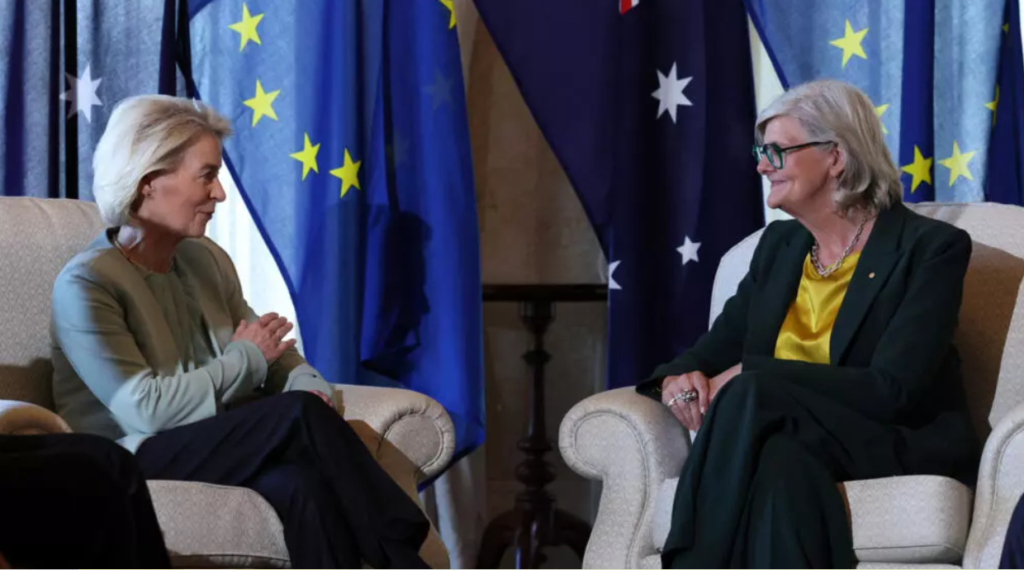
March 24, the European Union and Australia officially signed the “EU-Australia Free Trade Agreement” and the framework for a “Defense and Security Partnership” in Canberra. Negotiations for these agreements began in 2018; over the intervening period, they weathered various setbacks—including Australia’s cancellation of a conventional submarine procurement contract and bilateral disputes regarding agricultural market access—before finally reaching a consensus under the external pressure of a shifting global geopolitical and economic landscape. The agreements not only achieve large-scale tariff reductions for traditional goods and services trade but also deeply integrate the reshaping of critical mineral supply chains with the consolidation of a multi-billion-euro defense industry sector. This marks a substantive leap in bilateral relations toward an economic and security alliance, while also creating significant opportunities for investment and financial consulting, as well as government policy advisory services; furthermore, it holds profound implications for global supply chain restructuring and the geopolitical landscape of the Indo-Pacific region.
I. Specific Details of the Agreements
The signing of these bilateral agreements represents a major political compromise reached by both parties against the backdrop of intensifying great-power competition and the restructuring of global supply chains. Confronted by rising trade protectionism and anxieties regarding supply chain security, the EU and Australia set aside historical disputes—such as those concerning agricultural geographical indications and market access quotas—to construct an exclusive framework for economic and security cooperation, grounded in comprehensive tariff elimination and the opening of core industrial markets. This framework has now emerged as a core area requiring focused attention from the investment, financial, and government policy consulting sectors.
Regarding economic, trade, and mineral cooperation, the EU has immediately eliminated tariffs on approximately 98% of Australian goods exported to Europe, while significantly expanding tariff-free and low-tariff access quotas for Australian beef, lamb, and dairy products. In exchange, Australia has eliminated tariffs on over 99% of EU goods, fully opened its passenger vehicle market, and substantially raised the luxury car tax threshold specifically for European zero-emission electric vehicles. Concurrently, the two parties have established “four core projects” centered on critical minerals—including rare earths, lithium, and tungsten—and have completely eliminated export tariffs on relevant Australian minerals and green hydrogen derivatives shipped to Europe. This initiative aims to foster the development of a joint industrial chain—spanning everything from mining and refining to precursor manufacturing—thereby offering new directions for cross-border investment in the mineral and new energy sectors.
Notably, the agreements also incorporate an unprecedented “Defense and Security Partnership” component. This framework establishes an institutional pathway for Australian defense firms, enabling them to participate in the EU’s €150 billion “European Security Action” defense development initiative and joint equipment procurement programs. The agreement explicitly stipulates that, for defense products involved in joint procurement, the cost of components sourced from “non-trusted third countries” must not exceed 35%. Furthermore, both parties will establish a regular dialogue mechanism on security and defense to deepen cooperation in joint military operations—including maritime security coordination in the Indo-Pacific region, cyber defense, counter-terrorism intelligence sharing, and crisis management. This initiative will directly impact the landscape of transnational investment and collaboration within the defense and security sectors.
II. Analysis of the Parties’ Motivations for Cooperation
The EU’s primary motivation for signing this agreement is to implement its “de-risking” strategy and construct a bulwark against trade policy volatility. By securing access to Australia’s high-quality mineral resources, the EU can mitigate its deep reliance on single-country suppliers—a vulnerability exposed during its green transition and the revitalization of its defense industry—thereby safeguarding the security of its industrial and supply chains. Concurrently, integrating Australia into its own free trade network and defense procurement mechanisms serves a dual purpose: it expands the scale and scope of the European defense industry—facilitating the amortization of R&D costs—while simultaneously cementing the dominance of European standards within the defense systems of Western nations. This also serves to hedge against the uncertainties arising from protectionist tendencies among traditional allies, thereby providing a core entry point for policy consulting and investment analysis in these related fields.
Australia’s strategic considerations center on hedging against single-market risks and elevating the position of its domestic industries within global value chains. Canberra aims to leverage the EU’s vast consumer market to diversify its agricultural exports; simultaneously, by harnessing European capital and advanced technology, it seeks to transform its natural resource endowments into robust domestic capabilities in downstream refining and high-end manufacturing, thereby driving industrial upgrading. On the defense front, integrating into the European security network grants Australian defense contractors access to new channels for low-interest financing and cutting-edge military technologies, while mitigating the potential risks associated with over-reliance on a single ally’s security architecture. This, in turn, provides a crucial directional guide for investment consulting services targeting Australia’s relevant industries.
III. Global Implications of the Agreement and Consulting Service Orientation
The implementation of the EU-Australia Free Trade and Defense Agreement marks a quintessential shift in the international economic and trade system toward a “security-first” paradigm characterized by the formation of closed, bloc-oriented ecosystems. This transformation carries profound implications for global supply chains, the geopolitical landscape, and transnational investment flows, while also clearly defining the core service directions for consulting firms specializing in investment finance and government policy. From the perspective of global supply chains, the exclusive joint mineral projects and tariff-free corridors established by Europe and Australia—bolstered by rigorous environmental and social governance (ESG) compliance standards—will drive the targeted redirection of Australia’s strategic minerals toward European markets, thereby reshaping the global landscape for critical minerals and new energy supply chains. This development compels multinational corporations in relevant sectors to undertake supply chain adjustments and optimize their market positioning, while simultaneously opening up vast opportunities for investment consulting services.
In the dual-use technology sector, the stringent “rules of origin” quotas embedded within the EU’s defense financing mechanisms will prompt Australian defense and high-tech contractors to restructure their existing supply chains, fostering closer collaboration both domestically and across the EU. This imposes new requirements regarding investment strategy and compliance management within the defense and high-tech industries, while also emerging as a key focal point for government policy consulting and investment risk assessment.
Regarding the geopolitical landscape, the defense agreement between Europe and Australia signals an extension of European military influence and intelligence networks into the Indo-Pacific region. When viewed alongside recent initiatives—such as the U.S.-Japan “Action Plan on Critical Minerals” and the supply chain partnership agreement between Japan and South Korea—it becomes evident that the Western bloc is accelerating the construction of multilateral cooperative networks across the critical minerals, high-tech, and defense security sectors. This trend intensifies the bloc-oriented polarization of the geopolitical landscape in the Indo-Pacific, thereby necessitating that consulting services prioritize regional geopolitical risks and provide multinational investors with strategies for risk mitigation.
In light of the agreement’s impact, investment and financial consulting firms—as well as government policy consultants—should focus on three core service areas: First, Investment Opportunity and Risk Assessment: By analyzing the cooperative frameworks established between Europe and Australia in the minerals, new energy, and defense sectors, consultants can help multinational corporations identify potential investment dividends while alerting them to risks associated with supply chain restructuring and compliance reviews, offering tailored mitigation strategies. Second, Policy Adaptation Consulting: This entails a deep-dive analysis of the tariff policies, market access regulations, and defense cooperation clauses embedded within the EU-Australia agreements, enabling enterprises to align their operations with bilateral policy requirements and ensure regulatory compliance. Third, Regional Strategic Planning: By analyzing shifts in the Indo-Pacific geopolitical landscape, consultants can provide enterprises with recommendations for optimizing their global supply chains and regional investment portfolios, thereby leveraging the opportunities presented by EU-Australia cooperation to capitalize on investment prospects within these key sectors.
In summary, the signing of the free trade and defense cooperation agreements between the European Union and Australia has fundamentally reshaped the landscape of bilateral relations, while simultaneously exerting a profound influence on global supply chains and geopolitical security. Leveraging specialized expertise, investment and financial consulting—alongside government policy consulting—can assist multinational enterprises in adapting to changes in agreements, mitigating investment risks, and seizing collaborative opportunities. Concurrently, these services provide consulting support to relevant nations regarding policy implementation and the advancement of cooperation, thereby fostering mutually beneficial and win-win outcomes on both bilateral and global scales.