
Shirley Lin – Researcher
In the high-intensity operation codenamed “Epic Fury”—launched by a US-Israeli coalition against Iran—artificial intelligence has officially leaped from being merely an auxiliary tool to becoming the central nervous system of the entire combat system. During this operation, US forces utilized Palantir’s Project Maven to automate intelligence correlation and target prioritization; employed Anthropic’s Claude Gov system to process massive volumes of classified communications and simulate dynamic strike scenarios; and relied on Anduril’s Lattice software alongside Shield AI’s Hivemind system to command drone swarms in autonomous, collaborative operations within complex environments. This highly automated operational model—which drastically compresses the decision-making cycle—signifies that algorithms have formally restructured the entire kill chain. This transformation not only alters the balance of power in the Middle East but also creates a demonstrative effect on the global landscape of military competition, presenting major nations worldwide with entirely new challenges regarding the construction of intelligent combat systems.
I. The Structural Reshaping of Traditional Military Processes by AI
The core transformation in this latest round of operations lies in AI’s structural reshaping of traditional military processes, achieving a deep integration of data streams, algorithmic models, and combat platforms that fundamentally alters the logic of intelligence gathering, decision-making, and execution in traditional warfare.
At the level of intelligence integration, the US data analytics firm Palantir Technologies plays a pivotal role. Its “Maven” project serves as the machine-learning-driven foundation for intelligence, integrating satellite imagery, drone footage, signals intelligence data, and historical combat databases. Through algorithmic analysis, the system automatically identifies patterns in personnel movement, vehicle deployment frequencies, and the distribution of command nodes, subsequently prioritizing potential targets. The system not only generates target lists but also provides recommendations for appropriate weapon-target pairings and strike sequencing. The decision-making process has shifted from “humans searching for targets” to “algorithms filtering, humans confirming,” marking a fundamental change in the very starting point of decision-making. This model significantly compresses the time window between intelligence acquisition and strike execution, thereby accelerating the tempo of battlefield operations.
At the level of multi-source intelligence synthesis, the Claude system—developed by Anthropic—handles large-scale language model analysis tasks. Its “Claude Gov” variant is capable of processing thousands of hours of Persian-language communication intercepts and fragmented social media data within extremely short timeframes, identifying vulnerabilities within Iran’s defensive architecture, and generating multiple simulated strike scenarios based on historical combat precedents. The system automatically generates analytical reports—covering metrics such as target relocation probabilities, collateral damage assessments, and geopolitical risk projections—thereby providing decision-makers with comparative scenario analysis to support their strategic choices. In combat environments characterized by severe time constraints, artificial intelligence has enabled the simultaneous analysis of complex variables, giving rise to a “parallel algorithmic decision-making” paradigm.
Concurrently, OpenAI has been integrated into the U.S. defense cooperation framework, permitting its models to assist in military decision-making—provided such applications fall within the scope of “lawful uses.” The participation of numerous technology firms in military projects signals that the United States is currently forging an “algorithmic warfare ecosystem” centered on large-scale AI models. Algorithms are no longer mere standalone modules; rather, they have become the foundational logic embedded within the entire combat architecture, permeating every stage of the process—from intelligence gathering and decision-making to execution.
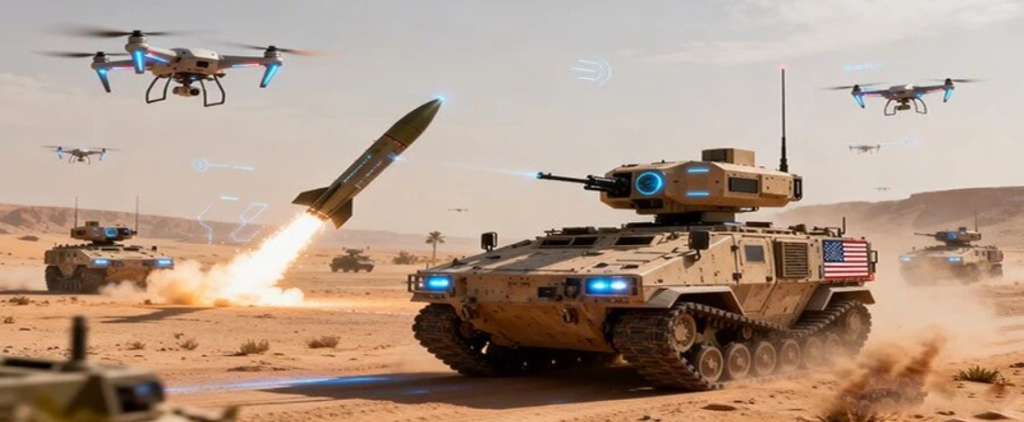
At the level of unmanned systems, the “Lattice” software developed by Anduril Industries and the “Hivemind” system created by Shield AI have endowed drone swarms with the capability to conduct autonomous, collaborative combat operations even amidst complex electromagnetic jamming environments. Should unmanned platforms lose their GPS signals or human control, they can leverage their onboard computing power to autonomously adjust formations, evade radar detection, share threat intelligence, and execute coordinated attacks. Algorithmic modules can be rapidly swapped out and upgraded, while hardware platforms continuously enhance their performance through software updates. The “software-defined weaponry” paradigm is diminishing the relative importance of traditional hardware advantages, positioning algorithms as the primary driver for the growth of combat power.
Overall, this latest round of operations demonstrates the comprehensive penetration of artificial intelligence across the three critical pillars of warfare: intelligence, decision-making, and execution. The tempo of the battlefield is now driven by algorithms; the human role has largely shifted toward oversight and validation, as traditional modes of military combat are being fundamentally reshaped by intelligent algorithms.
II. The Militarization of U.S. AI Enters the Fast Lane
Another significant implication of the recent operations against Iran is the revelation that the militarization of artificial intelligence in the United States has entered a phase of institutionalized, large-scale advancement—forming a complete closed loop that integrates policy, capital, and industry.
On the ethical and policy fronts, a public rift emerged between the U.S. government and Anthropic regarding whether the latter’s AI model, “Claude,” could be utilized in autonomous weapon systems. The company advocated for restricting the model’s application in fully autonomous lethal systems and domestic surveillance domains, whereas the government exerted pressure to the contrary, citing national security imperatives and supply chain risks. Subsequently, OpenAI swiftly reached a cooperative agreement with the Pentagon, authorizing the use of its models to support military decision-making within the framework of “lawful uses.” This sequence of events indicates that the ethical boundaries governing military AI in the United States are shifting from corporate self-regulation toward governance dominated by executive authority, with the demands of actual combat emerging as the primary driver for technological application. The “Responsible, Traceable, and Reliable” AI principles released by the Pentagon in 2020 originally emphasized explainability and controllability. However, in high-intensity conflict environments, efficiency and speed take precedence over ethical considerations. Realpolitik is currently constricting the ethical space for AI; the pace of technological application is significantly outpacing that of institutional regulation, and ethical boundaries are constantly being redefined in response to operational demands.
At the level of capital and industrial structure, the military-industrial complex is undergoing deep integration with Silicon Valley. In 2025, Palantir Technologies’ revenue from U.S. government contracts reached $1.9 billion, and its share price surged significantly following the outbreak of conflict. Analysts predict that, as military orders expand, the company’s revenue and market capitalization still have ample room for further growth. The U.S. Department of Defense has consolidated previously fragmented AI contracts into long-term, large-scale programs, establishing a stable funding mechanism that provides sustained support for military AI applications.
The commercial logic that “data is firepower, and algorithms are weapons” is being validated in actual combat. The boundaries between traditional defense contractors and AI companies are becoming increasingly blurred, with software and computing power emerging as strategic resources. The military drives algorithm upgrades through battlefield feedback, while corporations secure continuous investment via capital markets, thereby forming a closed loop—”battlefield validation leading to commercial expansion, and back to military application”—that continuously accelerates the militarization of AI.
It can be concluded that the militarization of AI in the United States is no longer merely an experimental endeavor; rather, it has been integrated into the national strategic framework as a long-term undertaking. Artificial intelligence is becoming a critical institutional pillar for the United States in maintaining its military superiority, while also charting the future course for the global development of military intelligence capabilities.
III. The New Landscape of Global Military Competition in the Era of AI Warfare
The practical application of AI by the U.S. and Israel in operations against Iran marks the formal entry of global military competition into the era of “algorithm warfare.” This development exerts a profound influence on the military development and technological strategies of nations worldwide, while simultaneously reshaping the core logic of global military rivalry.
From the perspective of technological security, the United States—by leveraging military requirements to drive upgrades in computing power and algorithmic systems—is exerting structural external pressure on the global ecosystem of high-end technologies. The demand for military applications has heightened reliance on high-performance computing platforms and specialized accelerator chips; consequently, computing resources are gradually being subsumed into national security frameworks, thereby attaining the status of strategic assets. Against this backdrop, global restrictions on technology exports are likely to become even more stringent, and competition among nations for dominance in high-end chips and core algorithms is poised to intensify. From the perspective of military security, AI-driven “decision compression” is shortening strategic warning windows, thereby introducing new uncertainties into the global security environment. Traditional high-intensity conflicts typically feature a relatively distinct preparatory phase; however, with algorithms now involved in intelligence filtering and strike path generation, the time required for operational planning has been significantly compressed. The autonomous collaborative capabilities of unmanned systems—particularly within complex electromagnetic environments—render battlefield operations more sudden and continuous in nature. As decision-making time shrinks to a matter of minutes or even seconds, the risks of miscalculation and escalation rise in tandem, presenting entirely new challenges for global crisis management. Consequently, some nations have begun to accelerate the development of their own autonomous intelligent combat systems in order to counter the security pressures posed by algorithmic warfare.
From the standpoint of industrial and defense-sector structures, the maturation of the U.S. “software-defined weaponry” model is reshaping the criteria by which global arms competition is evaluated. Within a framework that prioritizes the continuous upgrading of algorithms, the relative importance of hardware platforms has diminished, while the speed of software iteration has emerged as the critical variable for enhancing combat effectiveness. Through deep collaboration with technology firms, the United States has established a closed-loop system linking algorithm optimization cycles with battlefield feedback mechanisms, thereby driving the continuous upgrading of its weapon systems. The logic that “data is firepower, and algorithms are combat power” is currently reshaping the metrics used to measure military capabilities; in response, nations worldwide are adjusting their defense development strategies, significantly increasing their investment in the research and development of core algorithms and unmanned systems.
Regarding the realm of international norms and regulations, the rapid militarization of artificial intelligence is creating a regulatory vacuum. Currently, the Western bloc lacks a unified stance regarding lethal autonomous weapon systems, and globally, there remains an absence of any legally binding regulatory framework. The widespread application of AI in actual combat scenarios means that technological advancement is significantly outpacing the development of international institutions; this regulatory vacuum risks accelerating an “algorithmic arms race,” thereby further exacerbating the complexity of global military competition.
In summary, the joint U.S.-Israeli operation against Iran clearly demonstrated the pivotal role that artificial intelligence plays in modern warfare, signaling the formal arrival of the era of algorithmic warfare. The large-scale advancement of AI militarization by the United States is reshaping the global landscape of military competition. Nations worldwide now face a multifaceted array of challenges—encompassing technological upgrading, systemic restructuring, and regulatory maneuvering—and only by accelerating breakthroughs in core technologies and transforming their operational systems can they seize the initiative in this new round of military competition.